
SubAir Sport Systems Will Support Eight World Cup Stadiums World’s Ultimate Sporting Event to be Contested Using Latest Turf-Performance Technology
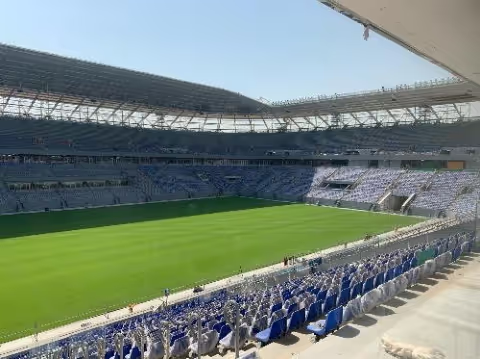
Lorem ipsum dolor sit amet, consectetur adipiscing elit. Suspendisse varius enim in eros elementum tristique. Duis cursus, mi quis viverra ornare, eros dolor interdum nulla, ut commodo diam libero vitae erat. Aenean faucibus nibh et justo cursus id rutrum lorem imperdiet. Nunc ut sem vitae risus tristique posuere.
All eight World Cup stadiums are located in a year-round arid desert climate, each with its own distinct microclimate. Doha alone hosts three separate venues. SubAir worked with World Cup representatives over 24 months to develop eight custom systems tailored to the individual microclimate demands of each stadium, using TurfWatch technology and wireless in-ground sensors to automatically adjust to live pitch conditions.
SubAir's TurfWatch technology programs each system to meet the specific needs of its individual stadium microclimate. Wireless in-ground sensors continuously monitor and relay subsoil conditions, while adaptive technology automatically adjusts moisture, oxygen, and temperature levels in real time — ensuring that ideal pitch performance requirements are met without requiring constant manual intervention from grounds crews.
The World Cup is the most widely viewed sporting event in the world, with cumulative viewership across all matches running into the billions. An estimated 715 million people watched the final match alone — more than one tenth of the global population. SubAir's selection across all eight Qatar venues positions the company as the definitive turf management technology at the world's most-watched sporting event.
Graniteville, SC (August 18, 2021) – With the 2020 Olympic Games complete in Tokyo, the eyes of the sports world turn to another major international competition, the 2022 World Cup, being played in Qatar from November 21 to December 18, 2022.
SubAir Sports Systems and their patented technologies have been chosen to support all eight of the stadium venues. The U.S.-based SubAir team—in partnership with its European distributor, Bernhard and Company—has been coordinating with World Cup representatives over the past 24 months to provide eight custom systems that meet the individual demands of each venue.
“The expectations set forth by the governing body are clear,” said Trey Crabill, Vice President, Sales of SubAir Systems. “The players are to have the highest performing pitches in the world, the games are to be played when scheduled without delays or cancellations, and the spectator experience will be electric as the most talented footballers in the world compete for soccer’s greatest prize. SubAir meets these criteria.”
All eight stadiums are in a year-round arid, desert climate, each with its own microclimate. Doha, Qatar’s capital city, will stage events in three separate venues. Opening ceremonies and the final match will take place in Lusail Stadium in the coastal city of Lusail, 14 miles north of Doha’s city center.
“SubAir Sport Systems have already been proven in every kind of climate. Besides the World Cup stadiums in Russia (2018) and Brazil (2014), our systems are in place in soccer and football stadiums around the globe,” said Brad Dennis, President, SubAir Systems. SubAir’s proprietary TurfWatch Technology ensures that each system is programmed to meet the needs of the individual microclimate within each stadium. The wireless in-ground sensors and adaptive technology of the SubAir Technological Systems guarantees that ideal pitch performance requirements are met as the SubAir Systems automatically adjust to live pitch conditions. Moisture, oxygen, and temperature will be monitored and controlled to ensure soccer’s most elite players are safe while competing on the most ideally conditioned pitches in the world.
This marks the third straight World Cup—across 13 stadiums—in which SubAir has provided system support.
Other recent SubAir installations in elite venues include:
Upcoming projects include:
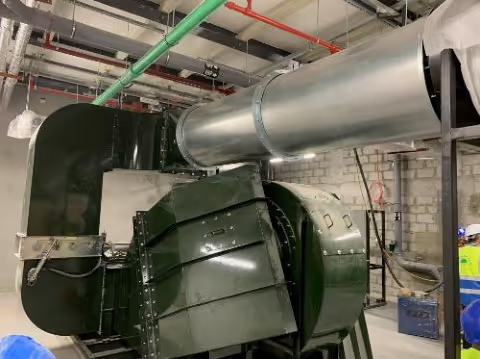

The World Cup is the most prestigious association football tournament in the world, as well as the most widely viewed and followed sporting event in the world. The cumulative viewership of all matches will be in the billions with an estimated 715.1 million people—more than a 10th of the planet’s population watching the final match on December 18.
The 2023 Women’s World Cup will be jointly hosted by Australia and New Zealand, July 20 to August 20, 2023. For the first time, the Women’s World Cup will be contest with an expanded field of 32 teams, up from 24.
The 2026 World Cup will be jointly hosted by Canada, the United States, and Mexico and will be the first World Cup to include 48 teams.
The SubAir Sport system is an essential component of turf-management equipment and technology. Combining engineering and agronomy with operations technology to create, monitor, and control the entire subsurface of the playing field to provide the best growing environment for natural turf.
SubAir’s latest technologies, including wireless in-ground sensors that relay subsoil conditions; a secure dedicated communications network; and proprietary computer programs to collect, relay, and interpret field-conditions data. This data activates aeration and moisture-control operations to proactively respond to changing field conditions. The systems’ proprietary technology allows turf-management teams to review all data and operate equipment through smartphones, computers, and digital notebooks.
The SubAir Sports System controls environmental impact improves turf recovery from high volumes of play, and monitors field consistency to produce firm footing while at the same time, ensuring player safety.

.svg)
.svg)

.svg)

